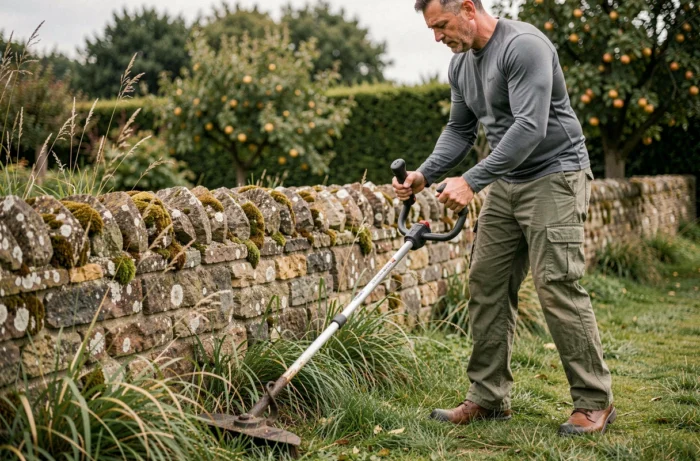
A brush cutter should not be chosen solely based on engine displacement or price. The type of vegetation, terrain configuration, and local regulatory obligations influence the choice much more than most buying guides suggest. Here, we detail the technical criteria that make the difference between a relevant purchase and a poorly calibrated investment.
Fire risk and legal obligations for brush clearing: adapting the machine to the regulatory framework
In municipalities exposed to wildfires, legal obligations for brush clearing (LOB) require maintaining a cleared area of at least 50 meters around buildings, which can be extended locally up to 100 meters. This perimeter can even exceed property boundaries.
A string trimmer or a lightweight brush cutter is sufficient for a well-maintained lawn. However, a property subject to LOB, with brambles, woody shrubs, and dense vegetation over several dozen meters, requires a machine capable of continuous operation over large areas, with a cutting system suitable for thick underbrush.
Municipal or prefectural orders also restrict the use of noisy machines, particularly on weekends. During periods of high fire vigilance, certain mechanical brush clearing tasks may be limited or prohibited. Checking local regulations before purchase prevents ending up with a thermal machine that is unusable for part of the year. A complete catalog of models suitable for each situation is available at debroussailleuse-warrior.com, allowing for comparison of engines based on these constraints.
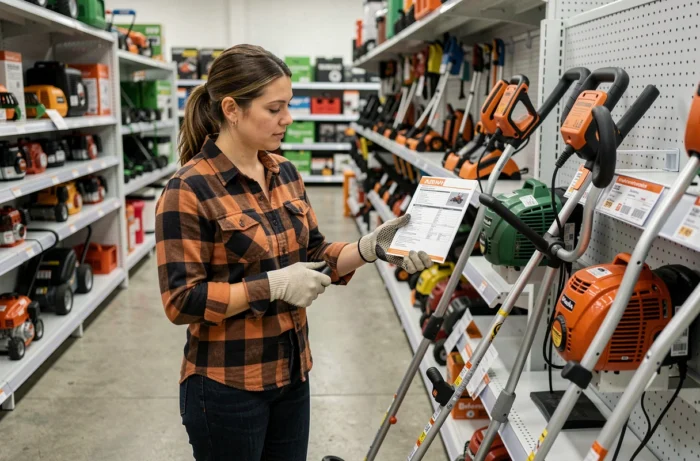
Thermal, battery, or electric motorization: beyond the simple power-to-weight ratio
The motorization determines the autonomy, available torque, and the actual operating range of the machine. The three families do not compete on the same grounds.
Thermal brush cutter and risk of ignition
The thermal engine (two-stroke or four-stroke) remains the reference for large areas and woody vegetation. Its high torque allows the use of brush blades or grass discs without loss of speed.
A rarely mentioned point of caution: the accumulation of dry grass around the exhaust or hot filters poses a real risk of ignition. Professional recommendations call for frequent cleaning of these areas and the availability of extinguishing means nearby on exposed sites. This parameter weighs heavily for properties in dry zones.
Battery brush cutter: real autonomy and pack voltage
Battery models improve each year in torque and autonomy. We recommend checking the pack voltage (36 V or 56 V minimum) rather than relying solely on amp-hour ratings. A high-voltage battery delivers more consistent torque in dense vegetation, where a low-voltage pack quickly loses power.
The absence of an exhaust eliminates the risk of ignition, a clear advantage in areas subject to LOB. The weight of the pack, carried in a backpack or attached to the machine, remains the main compromise.
Wired electric brush cutter
Limited by the cable, it is suitable only for small areas close to a power outlet. Its motor power is capped and does not allow the use of blades. It does not cover heavy brush clearing or uneven terrain.
Cutting system: line, blade, or disc depending on target vegetation
The choice of cutting system determines what the machine can actually cut. Confusing nylon line with a brush blade is like using pruning shears to fell a shrub.
- Nylon line (round or square): suitable for soft grasses, edge finishing, and lawns. Square line offers a cleaner cut on thick grasses but wears out faster on rocky terrain.
- Grass blade (three or four teeth): designed for tall and dense grasses, ferns, nettles. It does not replace a disc on woody brambles.
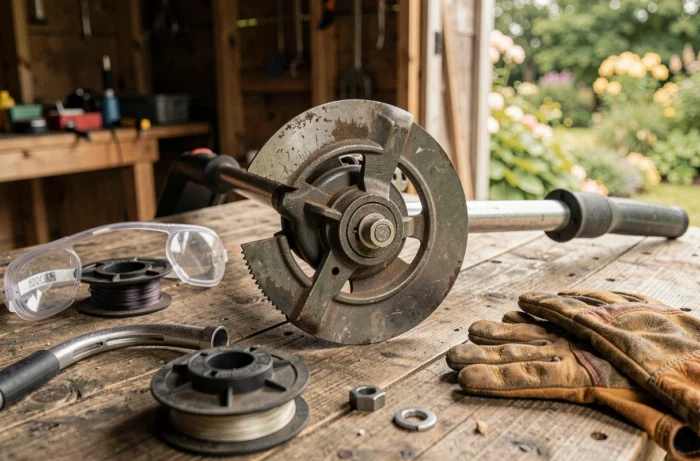
- Brush disc or bramble blade: the only effective system against underbrush, young shrub regrowth, and brambles. Requires a suitable harness and reinforced protective cover.
On mixed terrain (lawn + fallow area), a machine accepting multiple interchangeable cutting heads is the best investment. Check the compatibility of accessories with the angle drive of your model before purchase.
Personal protective equipment: a criterion for choosing the machine
Protective equipment should weigh into the decision, especially with a blade. Debris and plant fragments can reach speeds sufficient to cause serious injuries. The level of required protection varies directly with the cutting system mounted.
- Mesh visor or full-face shield for any work with a blade or disc.
- Cut-resistant leg guards as soon as the machine uses a brush disc.
- Hearing protection: thermal models exceed the comfort threshold, while battery models remain below this threshold.
- Anti-vibration gloves for long sessions on thermal engines, which transmit more vibrations than electric motors.
The total cost of PPE can represent a significant portion of the overall budget, especially for use with a blade. Integrating this item early in the machine selection phase avoids unpleasant surprises.
Ergonomics and harness: handlebar or grip depending on the type of work
The handlebar configuration (U or J shape) distributes the effort across both arms and is suitable for mowing large flat areas. It offers a wide and regular sweep, ideal for extensive brush clearing.
The loop handle, mounted on a straight tube, enhances maneuverability in cluttered areas: slopes, fence bases, around trees. However, it puts more strain on the wrist and leading arm during long sessions.
A distribution harness (forestry type with double straps) is non-negotiable beyond half an hour of continuous use. Simple single-strap harnesses are sufficient for lightweight string trimmers but cause muscular imbalances as soon as the machine’s weight exceeds a few kilograms.
The choice between handlebar and grip thus depends less on personal preference than on the terrain’s topography and the duration of sessions. Hilly terrain with obstacles calls for the grip, while a gently sloping meadow calls for the handlebar.