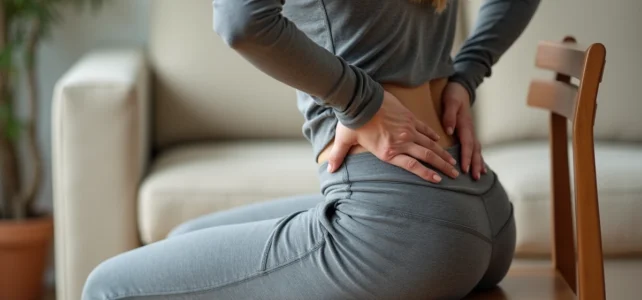
A pain that is concentrated in the buttock, sometimes not extending lower than the knee, does not always correspond to the classic picture of sciatica as it is usually described. Several distinct mechanisms can irritate the sciatic nerve at the level of the buttock, and confusing them delays management. This article compares the main clinical presentations responsible for buttock sciatic pain, their distinguishing characteristics, and the relief approaches suitable for each situation.
Truncated sciatica or piriformis syndrome: comparative table of buttock pain
The confusion between classic radicular sciatica and local irritation of the sciatic nerve in the buttock is common. Both cause pain along the nerve pathway, but their origin, precise location, and management differ. The table below summarizes the most useful differences to guide the diagnosis.
| Criterion | Radicular sciatica (herniated disc) | Piriformis syndrome | Truncated sciatica |
|---|---|---|---|
| Origin of compression | Nerve roots L4-L5 or S1-S2 at the lumbar level | Contracted piriformis muscle in the buttock | Radicular, but incomplete expression |
| Pain pathway | Lower back, buttock, thigh, calf, sometimes down to the foot | Mainly buttock, possible irradiation to the back of the thigh | Buttock and/or thigh, stops at the knee |
| Typical aggravation | Trunk flexion, coughing, sneezing | Prolonged sitting, hip rotation | Variable depending on the level of radicular involvement |
| Lumbar imaging | Visible disc anomaly (herniation, protrusion) | Often normal | Sometimes moderate disc anomaly |
The piriformis syndrome mimics sciatica without disc involvement. The piriformis muscle, located deep in the buttock, passes directly above or through the sciatic nerve depending on anatomical variations. When it contracts or thickens, it compresses the nerve locally. The pain then remains more concentrated in the buttock, without the typical electric shock that descends to the foot.
When the pain from the sciatic nerve in the buttock does not extend beyond the knee, clinicians refer to it as truncated sciatica. This presentation still points towards a radicular origin, but the irritation is insufficient to cause symptoms along the entire length of the nerve.

Buttock sciatic pain: why location changes the diagnosis
The distinction between “pure buttock” pain and pain radiating down to the foot is not trivial. It directly alters the diagnostic orientation and, consequently, the proposed treatment.
A complete irradiation down to the toes points towards a clear radicular involvement, often related to a lumbar herniated disc compressing the nerve roots L4-L5 or S1. Imaging (lumbar MRI) is then relevant to confirm the mechanism.
In contrast, pain that remains confined to the buttock and the back of the thigh raises the question of extra-spinal compression. The piriformis is the main suspect, but other structures may be involved: tension in the deep gluteal muscles, ischial bursitis, or irritation of the nerve at the level of the greater sciatic notch.
Clinical triage relies on specific physical tests. For piriformis syndrome, tensioning the muscle through internal hip rotation reproduces the buttock pain. For radicular sciatica, the Lasègue test (raising the straight leg) triggers pain along the entire nerve pathway.
Warning signs not to ignore
- Loss of strength in the foot or ankle (difficulty walking on heels or toes), which points towards severe radicular compression requiring prompt medical attention
- Sphincter disturbances (urinary or anal difficulties) associated with sciatic pain, which constitutes a neurosurgical emergency (cauda equina syndrome)
- Bilateral buttock pain with perineal numbness, a rare presentation but one that requires immediate consultation
These signals go beyond the scope of simple benign sciatica. Any loss of strength or sphincter disturbance associated with sciatica warrants an emergency consultation.
Relieving buttock sciatica: dynamic approaches rather than strict rest
The reflex to remain still in the case of buttock sciatic pain is understandable, but often counterproductive beyond the first few hours. Recent clinical recommendations emphasize maintaining moderate activity.
Alternating positions and taking short walks provides more relief than prolonged immobility. The goal is to find the position that eases the pain without worsening symptoms afterward. A sitting position that seems comfortable for ten minutes but causes a resurgence of pain upon standing is not a good pain-relieving position.
Targeted stretches according to the origin of the pain
For pain related to the piriformis, stretching this muscle is the cornerstone of management. The maneuver involves bringing the knee of the painful side towards the opposite shoulder while lying on the back and holding the position for about thirty seconds. Three daily repetitions are sufficient to notice improvement within a few days if the piriformis is indeed involved.
For radicular sciatica, McKenzie-type exercises (lumbar extension) are often recommended. The principle is to centralize the pain, meaning to make it rise towards the lower back while making it disappear from the leg. If an exercise causes the pain to descend lower in the leg, it should be stopped.
This centralization logic is a useful self-evaluation tool. An exercise that makes the pain rise towards the back is generally beneficial, while an exercise that makes it descend towards the foot likely worsens the compression.
Medical treatment for buttock sciatica: when exercises are no longer sufficient
When pain persists beyond a few weeks despite stretching and maintaining appropriate activity, several therapeutic options exist. The doctor may prescribe non-steroidal anti-inflammatory drugs to reduce inflammation around the nerve, or neuropathic analgesics if the pain takes the form of burning or electric shocks.
Corticosteroid injections (epidural for radicular sciatica, or perineural for piriformis syndrome) represent an intermediate step before considering surgical intervention. Surgery remains reserved for cases of severe compression with neurological deficit or after prolonged failure of conservative treatment.
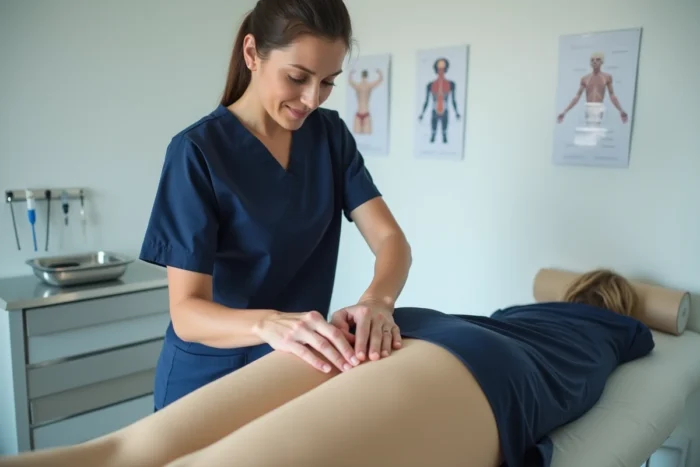
- Physiotherapy focusing on lumbar mobility and strengthening the stabilizing muscles of the pelvis, in addition to home stretching
- Osteopathy or chiropractic for associated joint blockages, provided that the diagnosis has ruled out severe radicular compression
- Gradual resumption of physical activity (walking, swimming) as soon as the pain allows, without waiting for complete symptom resolution
The majority of buttock sciatica resolves without surgery. The most determining factor remains the accuracy of the initial diagnosis: buttock pain related to the piriformis is not treated like a herniated disc, and confusing them unnecessarily prolongs the duration of symptoms.