Most guides to ageing well assume a mobile retiree with a strong support network and a comfortable budget. Standard recommendations—regular physical activity, a balanced diet and social connections—remain medically sound, but they become harder to put into practice when mobility declines, income is limited or support is lacking.
The law of 8 April 2024 established a framework by creating a departmental public service for autonomy, designed to better connect information, access to rights and guidance for older people. This scheme does not replace existing services; it aims to make them easier to navigate.
MaPrimeAdapt’ and home adaptations: an underused prevention tool
Adapting your home is a preventive measure that comes before everything else. Without an accessible shower, adequate hallway lighting or grab bars, advice on physical activity loses its relevance. MaPrimeAdapt’, introduced in 2024, helps fund some of the work, depending on household income and the person’s circumstances.
The scheme is aimed in particular at people aged 70 or over, as well as those aged 60 to 69 who are losing their independence. Eligible work ranges from replacing a bathtub with a level-access shower to installing a stairlift or widening doorways.
We find that many retirees are unaware of this assistance or confuse it with MaPrimeRénov’, which covers energy-efficiency renovations. Applications are submitted to the National Housing Agency (Anah), and an approved advisor assesses the person’s needs. Practical resources on retirees’ daily lives are regularly published on la-revue-des-seniors.com, including detailed guides to these support schemes.
Ageing well on a tight budget: nutrition, isolation and practical solutions
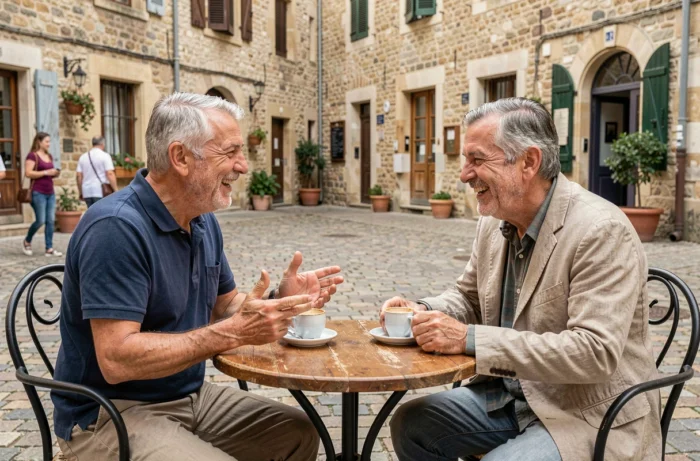
A limited budget makes it harder to maintain a balanced diet, especially when someone lives alone. Isolation compounds the problem: without someone to share a meal with, motivation to cook drops, meals become repetitive and the risk of malnutrition increases.
Les Petits Frères des Pauvres have documented this vicious circle. Their experience shows that isolation makes it harder to organise shopping and prepare meals. In response, the organisation offers adapted cooking workshops, shared meals and advice tailored to tight budgets.
Affordable options that don’t require major spending
- CCAS (municipal social services) often offer meal delivery at rates adjusted to income, sometimes for just a few euros per meal. Contacting your local town hall is a good first step.
- Community grocery stores and baskets of surplus fruit and vegetables (available through local associations) make it possible to maintain a varied diet without overspending on groceries.
- Group cooking workshops, such as those run by Les Petits Frères des Pauvres, combine social interaction with learning simple recipes that are accessible even to people with limited mobility in the kitchen.
The question isn’t whether you should eat five portions of fruit and vegetables a day. It’s how to do so when you’re living on a small pension and can no longer drive.
Independent living residences and social wellbeing: beyond the choice between home and a nursing home
Public debate often frames the choice as staying at home or moving into a medicalised care facility. Between the two, independent living residences offer a compromise that is rarely highlighted. These facilities provide private accommodation, shared spaces and group activities such as gentle exercise, memory workshops and cultural outings.
One point to note: prevention activities organised at these residences may be open to people from outside. A retiree living nearby can take part in workshops without living there, greatly expanding access to social life and adapted physical activities.
What to look for in an independent living residence
- The amount residents pay after housing assistance (APL) is deducted. Rates vary considerably depending on the municipality and operator.
- Whether there is a full-time coordinator or activities leader, which affects the quality and regularity of the activities on offer.
- Whether activities are open to non-residents, reflecting the residence’s connection to the neighbourhood and helping foster social connections.
- Proximity to shops, public transport and healthcare services, which determines how independent residents can really be in their daily lives.
Cognitive health and adapted physical activity when mobility declines
Cognitive stimulation doesn’t have to mean doing memory exercises on a tablet. Reading, board games and regular conversations with a variety of people engage executive functions in a more natural way.
As for physical activity, walking remains the cornerstone of preventive healthcare for older adults, even at low intensity. For those with very limited mobility, chair-based exercises—such as strengthening the upper body and practising balance while seated—have been shown to help prevent falls.
Prevention programmes run by pension funds, including “balance and fall prevention” workshops and “ageing well” programmes, are often free or available for a nominal fee. They can be accessed through the departmental public service for autonomy established by the law of 8 April 2024, or directly through your pension fund.
Mental health and stress management in retirement
Retirement removes the time markers provided by work. Without a set routine, some retirees experience a sense of disorientation that can lead to stress and anxiety. Structuring your week around two or three regular appointments—a group class, volunteering or a trip to the market—is often enough to restore a sense of routine.
Volunteering deserves special mention: it combines social activity, a sense of purpose and regularity. Local associations often struggle to recruit volunteers and are glad to welcome retirees, including for short-term or occasional roles suited to physical limitations.
Ageing well isn’t simply a matter of following a list of good habits. It depends on each community’s ability to make those habits accessible, including to people without a car, a nearby support network or spare money. The services are there. The challenge is making sure they reach the people who need them most.