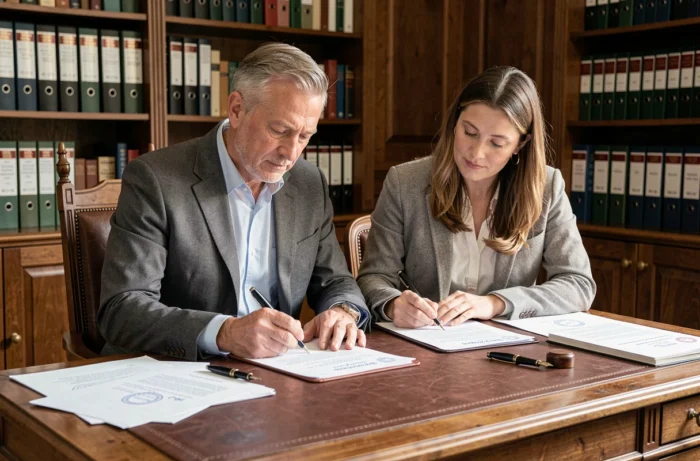
Giving half of your home to your spouse or partner involves notary fees, tax treatment that varies according to your relationship status, and direct consequences for inheritance. The actual cost of the transaction depends less on the property’s value than on the legal relationship between the partners: married couples, civil partners and unmarried couples are not entitled to the same allowances or subject to the same gift tax.
Gift tax by relationship status: different tax bills for the same property
Your marital status determines both the applicable allowance and the rate of gift tax payable. For the same property at the same value, the tax bill can vary threefold depending on whether the donor is married, in a civil partnership or cohabiting.
| Relationship status | Applicable allowance | Gift tax rates |
|---|---|---|
| Spouses (married) | Spousal allowance (renewable every 15 years) | Progressive rates for gifts between spouses |
| Civil partners | Same allowance as spouses | Same progressive rates as spouses |
| Unmarried couples (cohabiting) | Very low allowance | Flat rate of 60% on the value transferred |
The biggest difference applies to unmarried couples. An unmarried partner pays gift tax at a rate of 60%, making the transfer of half a house extremely costly without first getting married or entering into a civil partnership.
For married couples and civil partners, the allowance renews every fifteen years. If the value of the share transferred falls within the allowance, no gift tax is due. Above that threshold, progressive rates apply in bands.
Before taking this step, it is worth understanding the practical arrangements for transferring your share of a house to your spouse or partner and discussing your circumstances with a notary, who can explain the different scenarios in detail.

Notarised deed and actual costs of a property gift
Any gift of real estate requires a deed drawn up by a notary. No other form (a private deed or simple declaration) is legally valid for transferring ownership of a property.
Costs to budget for
Using a notary involves several separate costs:
- Notary fees, calculated according to a scale based on the value of the property transferred and set by decree
- Land registration tax, payable to register the transfer of ownership with the land registry
- The gift tax itself, calculated after applying the allowance based on the couple’s relationship status
- Additional costs (copies of deeds, mortgage formalities, property title searches)
One point that is often underestimated: notary fees are payable in addition to gift tax. Even when the allowance covers the entire value transferred and no gift tax is due, the notary’s fees and land registration tax still have to be paid.
Property with an outstanding mortgage
If a mortgage is still being repaid, gifting half of the property can create an issue with the lender’s security. The bank may require the loan to be repaid early or the security arrangements to be renegotiated. The lender’s consent is required before making the gift if the property is subject to a mortgage.
Forced heirship: the risk of a challenge by children
Tax is not the only obstacle. If the donor has children, the French Civil Code protects their inheritance through the forced heirship rules. The donor can freely dispose of only a portion of their estate (the disposable portion); the rest is reserved for protected heirs.
Giving away half of a house that represents most of the donor’s estate may infringe on this reserved share. The children may then bring a claim for reduction when the estate is settled to recover the share to which they are legally entitled.
This risk only arises when the donor dies, sometimes years after the gift. The recipient spouse or partner may therefore be required to compensate the protected heirs financially or even sell the property.
Gift of full ownership or gift with a retained life interest
To limit the impact on the reserved share and reduce the taxable value, the donor can make a gift while retaining a life interest, allowing them to continue living in the property or receiving income from it. Only the bare ownership is transferred to the spouse or partner, reducing the value subject to gift tax.
This arrangement offers two advantages: it reduces the tax payable and leaves more room to respect the disposable portion in relation to the children.
Civil partnerships and gifts: two pitfalls competitors don’t explain
Civil partners benefit from the same allowance and rates as spouses for gift tax. This tax equivalence creates the illusion of equivalent protection, even though a civil partner does not automatically inherit when their partner dies.
Without a will, the surviving partner receives nothing from the estate, regardless of the value of any gifts made during the donor’s lifetime. A gift protects the assets transferred during the donor’s lifetime, but it does not replace a will covering the rest of the estate.
The joint ownership regime under a civil partnership is a second pitfall. It applies only to assets acquired after the partnership is registered. A house owned by one partner before the partnership was entered into does not automatically become jointly owned. Amending the civil partnership agreement is not enough to transfer ownership of a property acquired earlier: only a notarised gift can do that.
Property gifts between spouses: summary of the required steps
- Check that the gift respects the disposable portion when there are protected heirs, with help from a notary who can assess the donor’s entire estate
- Obtain the bank’s consent if the property is subject to a mortgage or a lender’s lien
- Have a notary draw up the deed of gift, as only a notary is authorised to formalise a transfer of property ownership
- Register the deed with the land registry so the transfer is enforceable against third parties
A gift of real estate between spouses is irrevocable once accepted by the recipient. It can only be reversed in a very limited number of circumstances provided for by law. Before proceeding, couples should have the total cost of the transaction calculated precisely, including gift tax and notary fees, and assess the impact on their children’s inheritance rights.