
The composition displayed on the label of a bra or panties tells only a fraction of its real impact. Between GOTS certified cotton and cotton simply labeled as “natural,” the difference lies in chemical inputs, water management, and manufacturing conditions. To choose eco-responsible lingerie, it is useful to think in three layers: the fiber, the manufacturing chain, and the product’s end of life.
Eco-responsible lingerie certifications: what each label really covers
One label is not like another. We often observe confusion between OEKO-TEX Standard 100, which guarantees the absence of harmful substances in the finished product, and GOTS, which oversees the cultivation of the fiber, dyeing, weaving, and social production conditions. The former tests the result, while the latter audits the process.
The GRS (Global Recycled Standard) certification operates on another level: it verifies the actual proportion of recycled material in the fabric and traces its origin. Lace made from recycled polyamide bearing the GRS thus offers a measurable guarantee, whereas the simple mention of “recycled materials” on packaging does not.
Supply chain audits like SMETA add a social layer (working hours, wages, safety) that material certifications do not cover. Cross-referencing a material label with a social audit provides the most reliable level of verification. To delve deeper into these criteria, a comprehensive guide allows you to choose eco-responsible lingerie with informed knowledge.

Prioritizing labels according to your needs
- Skin sensitivity or endocrine disruptors: prioritize OEKO-TEX Standard 100, which targets chemical residues in direct contact with the skin.
- Overall environmental impact (water, pesticides, energy): require GOTS for organic cotton or GRS for recycled fibers.
- Working conditions in workshops: check for the presence of a SMETA audit or SA8000 certification in addition to the material label.
Fibers and durability in wear: organic cotton, Tencel, recycled polyamide
GOTS certified organic cotton remains the reference fiber for everyday lingerie. Its cultivation without synthetic pesticides reduces pressure on soils and groundwater. To the touch, the difference with conventional cotton is subtle when new, but we observe better fiber retention after several dozen washes, a criterion that committed brands are beginning to document.
Tencel (lyocell) is distinguished by its closed-loop management of the manufacturing solvent. The fiber is produced from wood pulp (eucalyptus, beech) and the process recovers almost all of the solvent used. The result is a thermoregulating, breathable material, suitable for pieces worn for long periods against the skin.
Recycled polyamide, often sourced from fishing nets or industrial scraps, allows for the design of lace and technical tulle without resorting to virgin fossil-based material. Its limitation: it remains a plastic, and each wash releases synthetic microfibers. A filtering laundry bag significantly reduces this dispersion.
Elastane: the component we forget
Almost all lingerie contains elastane for elasticity. This synthetic thread generally represents a small proportion of the fabric, but it complicates recycling at the end of life. The lower the proportion of elastane, the more recyclable the product will be. Some brands are working on bio-sourced alternatives, which are still marginal in the market.
Recyclability and end of life: an angle the market is just beginning to address
The majority of lingerie items mix two to four different fibers (cotton, elastane, polyamide, polyester). This blend makes mechanical or chemical sorting very difficult in current textile recycling streams.
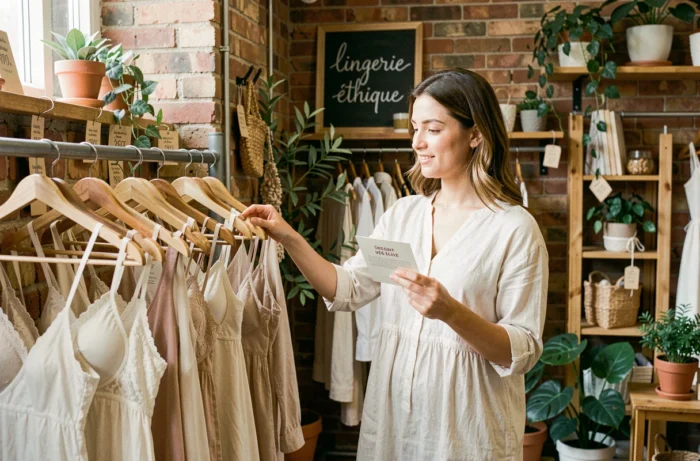
Some brands announce models designed to be fully recyclable, limiting the number of fibers and using dyes compatible with recycling processes. Designing for end of life rather than just for purchase marks a notable shift in approach. In practice, this means:
- Mono-material or maximum bi-material pieces, to facilitate sorting at the end of life.
- Dyes certified free from heavy metals, compatible with chemical recycling.
- Packaging made from recycled cardboard or upcycled fabric, integrated into the overall consideration of the product’s footprint.
- Take-back programs offered by some brands, which collect worn pieces to direct them to appropriate channels.
Sustainable comfort: evaluate performance after washes, not just initial softness
A fabric that feels nice in-store or upon first use does not predict its behavior after months of wear. We recommend checking if the brand communicates on the dimensional stability of its pieces (no deformation at the cup level, maintenance of band elasticity) and on color fastness to washing.
Sustainable lingerie must remain stable in wear and maintenance over several years. This criterion distinguishes a responsible purchase from a purchase that merely appears “green.” A bra that loses its support after a few months will be replaced, negating the environmental benefit of its production.
Care and longevity
Washing at low temperatures, on a delicate cycle or by hand, preserves both natural and synthetic fibers. Air drying prevents the thermal degradation of elastane. These actions extend the lifespan of each piece and mechanically reduce the volume of lingerie consumed over a decade.
The choice of eco-responsible lingerie is based on verifiable criteria: cross-referenced labels, detailed composition, recycling-oriented design, and documented longevity. Material alone is not enough. It is the entire cycle, from fiber to the last wash, that determines the real impact of a piece worn every day.