
A compact van for two is primarily a question of living space relative to road footprint. The double-deck concept, with an elevated sleeping area and a living space below, allows for a fixed bed, storage, and a kitchenette in a vehicle that remains under six meters. However, not all layouts are equal, and choosing the right configuration determines daily comfort.
Interior height and elevated bed: what makes a small van truly livable
Why talk about double-deck in a small van? Because the floor space is limited. In a vehicle like the Renault Trafic, Volkswagen Transporter, or short Citroën Jumper, every centimeter counts.
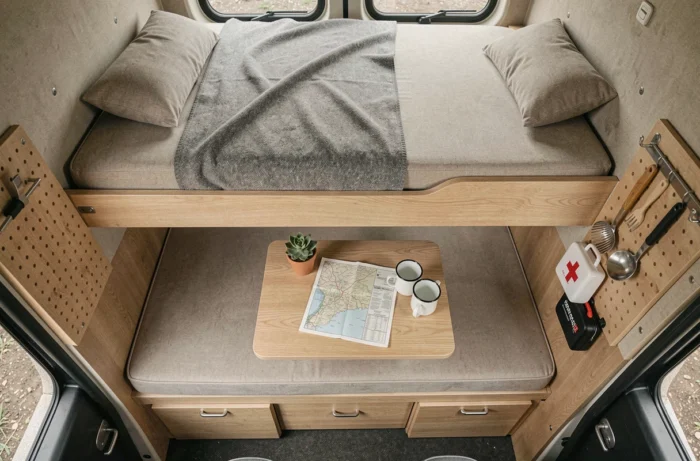
The principle is simple: the sleeping area is installed at height, often on a fixed or liftable platform, which frees up usable space below. This space serves as a garage, wardrobe, or technical area for the auxiliary battery and water tank.
The condition for this system to work: sufficient interior height to sit under the bed. An original raised roof (like a high roof H2) or a pop-up roof radically changes livability. Without this height, the elevated bed turns the living space into a corridor where you cannot stand.
When comparing two vehicles, measure the free height under the sleeping platform. If it drops below about ninety centimeters, the storage below becomes purely technical, and you lose the advantage of the double level.
To identify a small double-deck camper van suitable for your use, focus on the relationship between sleeping height and remaining living space, rather than just the vehicle’s length.

Removable kit or fixed layout: implications for VASP approval
This point is rarely addressed in buying guides, but it determines your freedom of choice and administrative procedures.
A fixed layout transforms the vehicle into a VASP (specialized self-propelled vehicle). Specifically, if you add a living unit to an already registered van, you go through an isolated approval process (RTI). This procedure involves a specific technical inspection and a modification of the registration document.
RTI processing times vary greatly by region, from a few weeks to several months. This is a factor to anticipate if you buy an empty van to have it fitted out.
The alternative: removable fitting kits avoid VASP approval as long as the vehicle’s structure is not modified. No drilling in the floor, no cutting of the roof, no change in the number of seating places. The van remains a utility vehicle on its registration document, and you install or remove the kit as needed.
For a couple who also uses the vehicle during the week, this modularity has a concrete advantage: you switch from a work utility to a weekend van without double registration.
What the removable kit does not replace
A modular kit offers flexibility, but it imposes compromises. Thermal insulation is often less effective than a glued and screwed layout. The furniture, designed to be dismantled, sometimes lacks rigidity on the road.
If you plan long trips or stays at altitude, a fixed layout with complete insulation will be more suitable. The choice depends on the frequency and duration of your travels.
Sleeping, cooking, and storage: balancing space in a compact van
In a short van, you cannot have it all. The layout requires trade-offs between three areas that compete for the same volume.
- The fixed bed in width occupies the entire rear width of the vehicle. It offers a ready-to-use sleeping area without manipulation but blocks access to the garage from the inside. For two travelers, a bed at least 130 cm wide ensures decent comfort.
- The side kitchen unit fits between the sliding door and the rear. It generally includes a sink, a two-burner stove, and a small work surface. Its depth determines the remaining passage space: aim for at least forty centimeters of free corridor to move around without contorting.
- High storage utilizes the volume above the kitchen and lounge area. Closed cabinets are preferable to open shelves: while driving, anything not secured ends up on the floor.
A common pitfall: choosing a model with an integrated bathroom in a van shorter than five meters fifty. The shower cabin and fixed toilet consume a disproportionate volume compared to their actual use. For a duo, portable toilets and a solar shower are a more rational compromise in a small size.
Used diesel vehicle or new van: how the choice of base vehicle changes things
The chassis determines the budget, reliability, and fitting possibilities. Two main families stand out in the used market.
Compact vans like the Renault Trafic, Volkswagen Transporter, or Opel Vivaro offer a driving experience similar to a car. Their size allows access everywhere, including city centers and covered parking. In diesel, they remain the most common on the used market.
Medium vans like the Fiat Ducato, Peugeot Boxer, or short Citroën Jumper offer more interior volume. The height under the roof in H2 version allows you to stand up, which transforms onboard comfort.
Points to check on a used vehicle
- The condition of the floor under the layout: moisture seeps through the rear door seals and causes invisible corrosion under the furniture
- The actual mileage relative to the vehicle’s age: a utility diesel with low mileage may indicate repeated short trips, which are more taxing on the engine than long highway driving
- The maintenance history of the timing belt and turbo, two costly repair areas on common diesel engines in this category
On a new vehicle, the manufacturer’s warranty covers the chassis but rarely the layout. Check the warranty conditions of the fitter separately, especially regarding the waterproofing of the pop-up roof if the vehicle is equipped with one.
The used market offers access to models already fitted out by recognized professionals, often at a price significantly lower than new. A well-inspected used van protects just as well as a new model, provided you do not overlook the inspection points mentioned above. The final choice depends on your budget, your tolerance for mechanical risk, and the time you are willing to dedicate to approval processes if the layout is not already validated.