
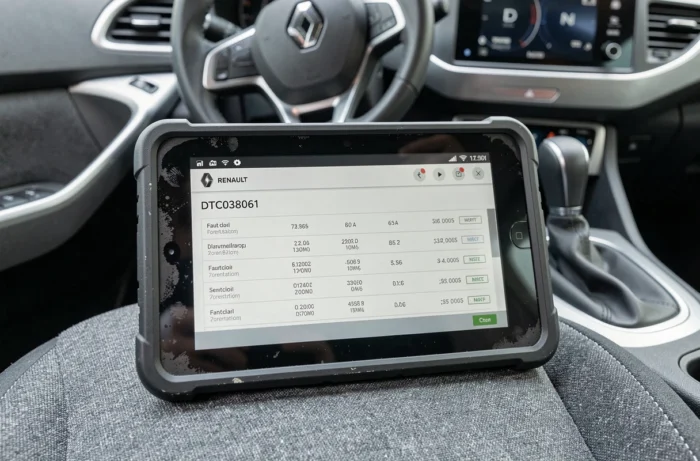
The fault code DTC038061 appears during a diagnostic reading on certain Renault diesel models. It indicates an anomaly detected by the engine control unit in the glow plug circuit. Before any intervention, understanding the exact nature of this code and the associated diagnostic logic prevents unnecessary parts replacements.
DTC038061 Renault Code: Difference Between Manufacturer Code and Generic OBD Code
A technical point deserves to be made from the outset. Multi-brand diagnostic tools display standardized codes in the “P” format (like P0380), while the Renault manufacturer tool uses a proprietary format such as “DF” or “DTC”. The same number can cover different realities depending on the model, year, and onboard control unit.
Specifically, DTC038061 is often associated with the generic code P0380, which points to a malfunction in the “A” glow plug circuit. This equivalence is not systematic. It depends on the engine control unit installed in your vehicle.
To clarify any doubts, the technical documentation from Renault corresponding to your engine and control unit remains the reference. A manufacturer-compatible tool (like CLIP or equivalent) displays the exact wording of the fault, the triggering conditions, and the status of the code (active or stored). The information available in the form of Renault code on Auto Test helps guide an initial search before delving deeper with the appropriate tool.
Diesel Glow Plug Circuit: Operation and Role in the Fault
The glow plug circuit prepares the combustion chamber of a diesel engine for starting. Each cylinder receives a glow plug whose internal resistance heats the chamber for a few seconds before and after the engine starts.
The control unit manages this circuit in two phases. The preheating phase raises the temperature to facilitate fuel ignition. The post-heating phase maintains a sufficient temperature during the first minutes of operation, which reduces emissions and stabilizes idle.
When the control unit detects an electrical anomaly in this circuit, it records a fault code. The problem can occur at several levels:
- One or more glow plugs with internal resistance out of tolerance, indicating wear or failure of the heating element
- The glow plug relay (or electronic control unit in newer systems) that no longer delivers the expected voltage to the plugs
- A connectivity issue: oxidized terminals, broken wire, or poor ground between the electrical harness and the engine block
Each cause produces similar symptoms, making electrical measurement necessary before any replacement.
Electrical Diagnosis of DTC038061: Method Before Replacement
The common temptation is to directly replace the glow plugs. This approach works if the plugs are indeed the issue, but it overlooks two frequent sources of faults: the battery and electrical grounds.
Check Battery Voltage and Grounds
A battery with too low voltage alters the behavior of the glow plug circuit. The relay or control unit does not receive enough current to properly power the plugs. The control unit interprets this lack as a fault in the circuit.
The ground points on the engine block and the body should be visually inspected and tested for continuity with a multimeter. An oxidized or poorly tightened ground terminal is enough to cause an intermittent fault code.
Test Glow Plugs with a Multimeter
Each plug is tested individually. By measuring the resistance between the power terminal and ground, a functional plug shows a low value (a few ohms). An infinite resistance indicates a broken plug. An abnormally high value suggests a degraded heating element.
This test takes a few minutes per cylinder and allows for precise identification of the faulty plug(s) without blindly replacing everything.
Check the Relay or Control Unit
The glow plug relay (in classic systems) or the electronic control unit (in newer architectures) is checked by measuring the output voltage during a preheating command. If the expected voltage does not reach the plugs despite functional plugs and a good battery, the relay or control unit is at fault.
Record Data Before Clearing the Fault Code
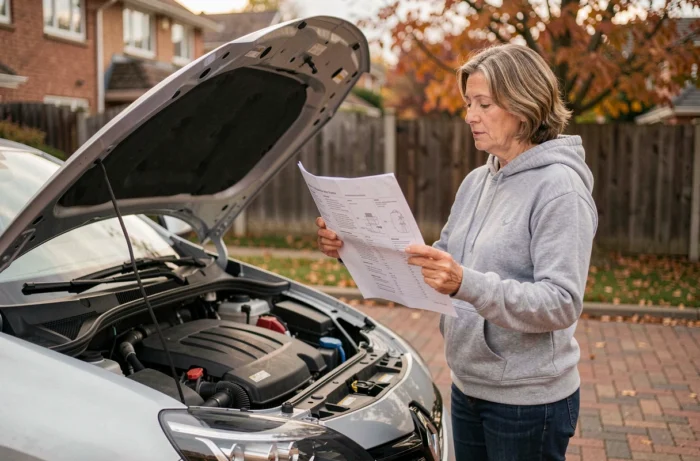
A common reflex after reading the code is to clear it immediately to see if it returns. This approach loses useful information.
Before any clearing, record the active and stored codes as well as the conditions logged at the time of the fault’s appearance. Engine temperature, battery voltage, and RPM at the time of triggering guide the diagnosis. A code that consistently appears when cold points to the plugs or relay. A code that appeared after an intervention on the engine harness points to a connectivity issue.
After noting these elements, clear the code, then perform a real-world test (preferably a cold start). If the fault returns, you have a comparative history. If the code remains absent, it may be a one-time fault related to temporarily insufficient battery voltage.
Symptoms Associated with Renault Glow Plug Fault
The malfunction of the glow plug circuit manifests through concrete signs in daily use:
- Difficult starting in cold weather, with a longer than normal cranking time
- White or bluish smoke from the exhaust during the first minutes of operation
- Unstable idle in the seconds following startup, sometimes accompanied by engine vibrations
- Check engine light illuminated on the dashboard, sometimes accompanied by the glow plug light (spiral) that remains steady or blinks
These symptoms worsen in winter when preheating plays its most critical role. A faulty glow plug circuit does not cause immediate failure, but it gradually deteriorates starting conditions and may increase fuel consumption.
The DTC038061 code on Renault refers to a glow plug circuit that should be methodically investigated. Checking the battery, grounds, plugs, and relay in that order prevents replacing healthy parts. Keeping the data recorded by the control unit before clearing the code remains the best starting point for reliable diagnosis.