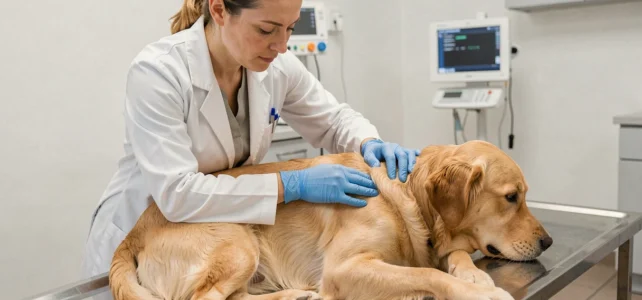
A dog dragging its rear on the ground, suddenly turning towards its tail, or compulsively licking the perianal area: the picture is quickly recognizable. Behind these behaviors, an engorged anal gland can silently evolve into a painful abscess. Understanding the mechanics that lead from impaction to rupture allows for action before the situation becomes a veterinary emergency.
Soft stools and ineffective emptying: the often underestimated mechanism
The emptying of the anal sacs depends on a simple mechanical principle: at the time of defecation, firm stools compress the glands and expel their contents. When the stools are too soft, this pressure does not exert properly. Secretions stagnate in the anal sacs, thicken, and eventually block the excretory duct.
This is referred to as impaction. At this stage, the dog does not yet have an infection, but the groundwork is laid. Chronic soft stools are the primary factor for mechanical blockage. However, the consistency of the stools directly depends on the diet, and this is the lever on which we can act the earliest.
To understand the causes of anal gland abscess in dogs, it is essential to keep this timeline in mind: impaction, then bacterial infection, then abscess, and possibly subcutaneous rupture. Each step leaves a window for intervention, but the first remains the easiest to correct.
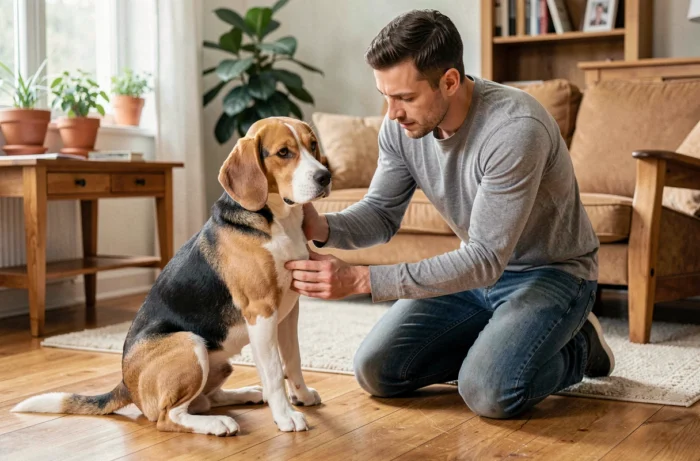
Allergies and inflammatory terrain: a neglected factor for recurrence
A dog whose anal glands regularly become engorged despite having normal stools often has an underlying allergic problem. Food or skin allergies cause chronic inflammation of the perianal tissues and excretory ducts. The diameter of these ducts decreases, secretions flow poorly, and the impaction-infection cycle begins anew.
Allergy is a common cause of recurrences that many owners do not connect to anal gland problems. The abscess is treated, the sacs are emptied at the veterinarian, but if the allergic terrain is not managed, the problem returns within weeks.
Feedback on this point varies by breed and individual, but atopic dogs or those with food intolerances are overrepresented among consultations for recurrent abscesses. A food elimination diet supervised by a veterinarian can sometimes resolve the problem at its source.
Dog overweight and perineal compression: the direct mechanical obstacle
Being overweight is not just a vague risk factor. In an overweight dog, perineal fat physically reduces the compression exerted on the anal sacs during defecation. The natural emptying mechanism becomes less effective, even with well-formed stools.
This phenomenon is observed in predisposed small breeds (Poodle, Cavalier King Charles, Chihuahua), but also in medium-sized dogs that have become sedentary. The loss of muscle tone in the perineal region further exacerbates the problem.
An overweight dog experiences a double effect: fat that hinders compression and a lack of physical activity that softens the musculature. Both act on the same blockage point.
Warning signs before the abscess: what to spot at home
The progression from impaction to abscess leaves detectable signals if you know what to observe. Here are the behaviors and physical signs to monitor in the usual order of appearance:
- The dog is scooting: it rubs its anal area on the ground, indicating discomfort or engorgement of the anal sacs that are trying to empty
- Excessive licking of the anal region and the base of the tail, sometimes accompanied by nibbling, indicating increasing local irritation
- Visible swelling on one side of the anus, with tight, red, or purplish skin, indicating that the infection is established and pus is accumulating
- Pain during defecation: the dog pushes without result, changes position, or whines, indicating that the pressure on the infected gland has become unbearable
- Purulent or bloody discharge near the anus, indicating that the abscess has ruptured under the skin, a situation described as a veterinary emergency requiring drainage and antibiotic treatment
The earlier you intervene in this sequence, the less intensive the treatment will be. An impaction detected at the scooting stage often resolves with a simple manual emptying at the veterinarian.
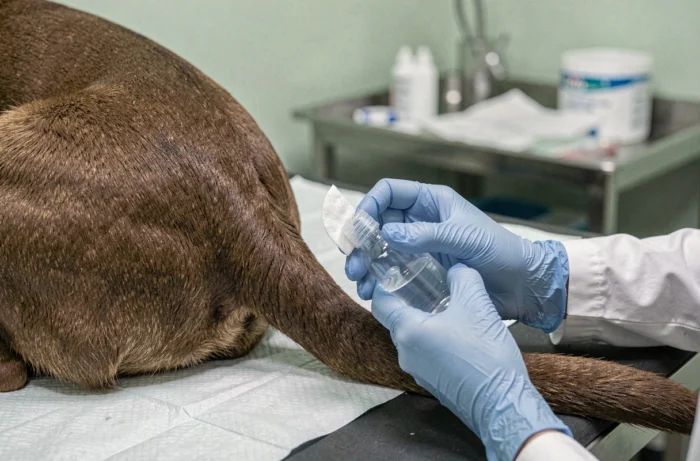
Prevention of anal gland abscess: concrete levers
Prevention relies on three axes that directly address the mechanical and inflammatory causes described above.
Quality of stools and fiber intake
Restoring firm stools is the most effective preventive lever. Sufficient dietary fiber intake (through diet or an appropriate supplement) gives stools the volume and consistency necessary to naturally compress the anal sacs. This helps prevent the stagnation of secretions at the source.
Weight management and physical activity
Keeping the dog at a correct weight preserves perineal mechanics. Daily exercise also contributes to muscle tone in the area, facilitating natural emptying. An active dog at its ideal weight has significantly less risk of chronic engorgement.
Monitoring underlying allergies
For dogs prone to recurrences, an allergy assessment can identify inflammatory triggers. A hypoallergenic diet or appropriate dermatological treatment reduces inflammation in the excretory ducts and breaks the cycle of reinfection.
Preventive emptying at the veterinary clinic remains useful for at-risk dogs, but it does not replace addressing the causes. Multiplying manual emptyings without correcting diet or weight amounts to treating the symptom in a loop. In the long run, repeated expressions can even irritate the tissues and worsen the problem. A comprehensive veterinary assessment, integrating diet, weight, and allergic terrain, allows for the construction of a truly effective prevention protocol.