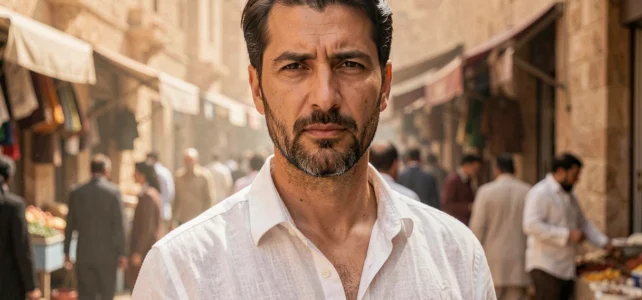
The cancellation of Messiah in March 2020 remains a case study in the streaming industry. The series created by Michael Petroni, featuring an international cast including Tomer Sisley, Mehdi Dehbi, and Michelle Monaghan, was cut after just one season even though a season 2 had been internally confirmed. Understanding why Messiah will never have a sequel on Netflix requires looking beyond the simple argument of the pandemic.
Multi-country filming and post-COVID production cost explosion
The narrative structure of Messiah required filming in Jordan, New Mexico, Washington, and several other international locations. This multi-country format, already costly under normal circumstances, became a budgetary black hole as health restrictions emerged in early 2020.
The COVID protocols applied to international productions (mandatory quarantines, health bubbles, daily testing) significantly multiplied the budget per item. For a series whose model relied on constant travel between continents, the logistical overcost made season 2 economically unfeasible.
We observe that this angle is often reduced to “the pandemic stopped everything,” which obscures the industrial reality. Other Netflix series filmed on a single set or in one country survived the same period. It was the combination of multi-country filming and health crisis that sealed the fate of Messiah, and a detailed article outlining the reasons for the absence of season 2 for Messiah specifically addresses this mechanism.
Netflix internal metrics: why Messiah no longer passed the renewal filters
Since 2021, Netflix has tightened its renewal criteria. Three indicators dominate the internal decision grid:
- Completion rate: the percentage of viewers who watched the series until the last episode. A low rate signals a narrative drop-off that the algorithm heavily penalizes.
- Net subscriber acquisition: the ability of a program to generate new subscriptions or retain those considering cancellation.
- Cost per hour viewed: the ratio between the production budget and the total number of hours consumed by subscribers. The more expensive the filming, the more favorable this ratio needs to be.
Messiah, with its high budget linked to international locations and a polarized audience due to its religious subject matter, presented an unfavorable profile on these three axes. The series attracted an engaged audience but was numerically insufficient to justify renewal against less costly productions generating more viewing hours.
These performance filters did not exist in this form in 2020. Their retrospective application to the catalog confirmed that Messiah would not be revived, even once health constraints were lifted.
Geopolitical controversies and diplomatic pressure on Netflix
The pitch of Messiah touched on a reputationally high-risk subject: the emergence of a contemporary messianic figure in a conflict context in the Middle East. The series provoked hostile reactions in several countries even before its broadcast.
Netflix faced legal action related to the series. Petitions demanding its removal circulated, and some countries requested that the content be taken off their local catalog. This diplomatic pressure was a rarely quantified but crucial factor in the platform’s risk-benefit calculation.
For a service present in over 190 territories, the risk of regional blocking or boycotting weighs as heavily as viewership. Renewing Messiah would mean reigniting a cycle of controversies in strategically growing markets for Netflix, particularly in the Middle East and Southeast Asia.

Probability of revival or pickup by another broadcaster
Several years after the cancellation, Messiah does not appear in any revival, spin-off, or competitor pickup scenarios. Recent inventories of Netflix series that are definitively finished consistently categorize it as “no prospect of return.”
Michael Petroni, the showrunner, has publicly expressed his desire to continue the story. This creative wish is not enough. The rights remain with Netflix, which has no economic interest in ceding or exploiting them. The resale pattern observed for other canceled series (buyout by Amazon, pickup by a network) has never been initiated for Messiah.
Three factors definitively lock the situation:
- The contracts of the main actors have expired, which would require a complete renegotiation of the cast at likely higher rates.
- The geopolitical subject remains as sensitive as in 2020, if not more so given the evolution of conflicts in the Middle East.
- No competing broadcaster has publicly expressed interest in acquiring the rights to the series since its cancellation.
What the cancellation of Messiah reveals about Netflix’s catalog strategy
Messiah illustrates a turning point in Netflix’s catalog management. The platform has shifted from a logic of abundance (massively producing, broadly renewing) to a logic of profitability per title. Series with a “niche passionate but costly” profile are the first victims of this shift.
This model structurally penalizes ambitious productions with an international dimension. A series filmed in a single country with a local cast costs a fraction of Messiah’s budget for a comparable, if not superior, audience potential thanks to algorithmic recommendations that favor broadly appealing content.
Fans of Messiah who still hope for a return are confronted with this industrial reality. The series was not canceled for artistic reasons but due to a confluence of economic, logistical, and geopolitical constraints that, far from dissipating over time, have intensified. The Messiah case is closed, and no signals in the industry suggest its reopening.