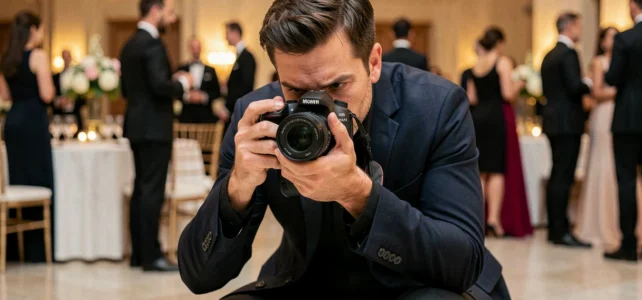
The profession of event photographer is based on a constant tension between technique, speed of execution, and artistic sensitivity. Unlike studio photography, where control over light and decor is total, covering an event requires dealing with the unexpected, changing lighting conditions, and fleeting human interactions. This demanding and loosely defined work environment is rapidly evolving due to new digital practices and still poorly defined legal issues.
Right to image in events: a legal framework more complex than it seems
The dissemination of photographs taken during an event is not simply a matter of common sense. The right to image in France is based on Article 9 of the Civil Code and the provisions of the GDPR when biometric data comes into play (facial recognition, automated sorting of faces).
For an event photographer, the difficulty lies in the multiplicity of situations. A crowd photo at an outdoor concert does not require the same precautions as a close-up portrait of a guest at a private gala. The simple right to image is no longer sufficient when the images are combined with facial recognition tools or integrated into personalized marketing devices, as highlighted by Evenement.com in an analysis published in August 2026.
Field feedback varies on this point: some organizers believe that the mention “by participating, you agree to be photographed” on an invitation card covers their obligations, while specialized lawyers remind that this type of clause has no binding legal value without explicit and informed consent. A photographer who regularly works in events benefits from formalizing their own consent collection protocols, distinct from those of the organizer.
Professionals like Eyes Wide Shoot illustrate this approach where legal rigor accompanies the creative process, with each service incorporating a reflection on the use and dissemination of the produced images.
Artificial intelligence and event photography: what is changing concretely
The majority of event solutions now integrate at least one feature related to artificial intelligence. For the photographer, this translates into tangible modifications in the workflow.
Accelerated sorting and delivery of images
AI-powered automated sorting significantly reduces post-production time. Algorithms analyze sharpness, composition, and facial expressions to pre-select usable shots. The photographer retains the final decision, but the volume of mechanical work decreases.
Personalization of the photo journey
Some events offer participants the chance to receive “their” photos in real-time, thanks to facial recognition coupled with a mobile app. The event photographer then becomes a link in a broader technical chain, which requires dialogue with the organizer’s data and marketing teams.
This evolution raises a fundamental question about the role of the photographer. AI accelerates delivery but does not replace the eye. The choice of angle, the ability to anticipate a gesture, the decision to trigger at the precise millisecond remain human skills. The available data does not allow us to conclude that automation threatens the profession; rather, it modifies its contours.
Equipment and technical choices of the event photographer
The choice of equipment directly reflects a photographer’s creative vision. Two practitioners covering the same event with different equipment will produce radically distinct images.
- High ISO sensitivity cameras allow for working in low natural light (reception halls, concert stages) without resorting to flash, preserving the ambiance and the photographer’s discretion.
- Bright fixed focal length lenses (wide aperture) offer pronounced bokeh that isolates the subject from the background, a rendering favored in wedding and event portrait photography.
- A second camera equipped with a versatile zoom ensures responsiveness to unexpected events: sudden speeches, arrival of a guest, change in room configuration.
- Off-camera flash, used in bounce or with a diffuser, remains a backup tool for extreme backlighting situations or dance parties.
Equipment does not make the photo, but it conditions the possible creative choices. An event photographer who works without flash imposes a documentary and immersive style. One who masters artificial lighting can create posed portraits amidst the flow of an event. These two approaches coexist and meet different client expectations.
Originality of photographs: a legal and artistic criterion
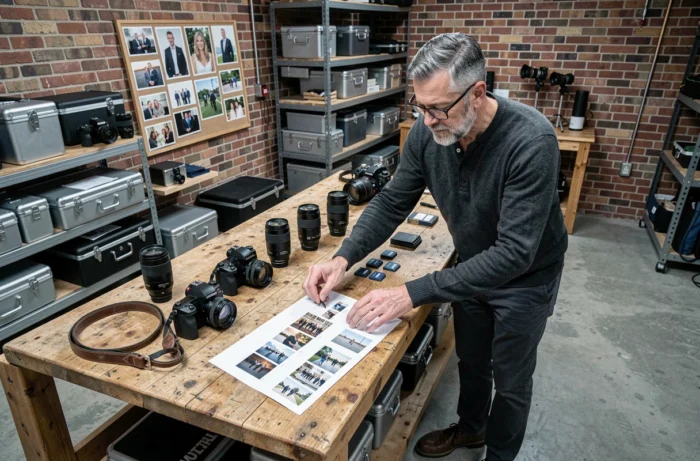
Under French law, a photograph is protected by copyright only if it is considered “original,” meaning it bears the imprint of its author’s personality. Recent case law on this subject, analyzed by several law firms specializing in intellectual property between 2024-2026, shows that the originality of an event photograph is not self-evident.
A purely factual shot (group photo in front of a roll-up, standard framing of a podium) may be denied protection. In contrast, a work of composition, lighting, or post-processing that reveals an aesthetic bias will suffice to establish originality.
For the event photographer, the practical consequence is twofold. Creatively, they have an interest in asserting an identifiable style, whether through the choice of black and white, an atypical framing, or a unique color treatment. Legally, this approach strengthens the protection of their images against parasitism, meaning unauthorized reuse by third parties.
Building a coherent photographic universe in events
A passionate event photographer does not simply deliver files. They build a recognizable visual identity from one event to another, through carefully curated galleries, art prints, or narrative series that tell the event as a story.
This coherence comes from deliberate choices: recurring color palette, relationship to movement, emphasis on details (hands, textures, reflections) versus wide shots. It is also constructed through dialogue with the client beforehand to understand the tone of the event and adapt the coverage.
The market for event photography in France remains fragmented, without a dominant aggregator. Differentiation relies on style as much as on technical reliability. A photographer whose work is recognized before reading their signature has a competitive advantage that neither AI nor price competition can easily erode.