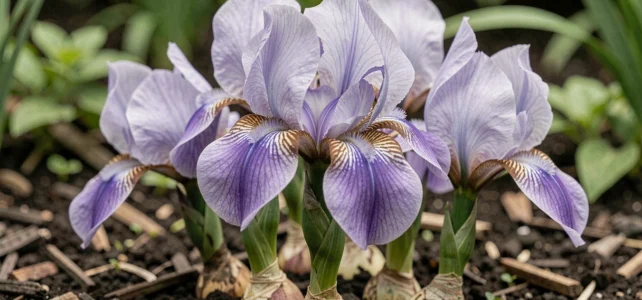
The walking iris (Neomarica northiana, reclassified as Trimezia northiana) is a tropical rhizomatous plant from the Iridaceae family, native to Brazil. Often presented as a low-maintenance houseplant, it raises a rarely asked question in cultivation guides: does its behavior in the ground vary by region, and should its status be checked before planting it in the garden?
Walking iris in pots or in the ground: two distinct behaviors
Most cultivation sheets treat the walking iris as a docile houseplant. In pots, its growth is indeed contained by the volume of available substrate. The fan-shaped leaves reach a moderate size, and the plant produces its aerial offsets without ever overflowing the container.
In the ground, the dynamics change. The rhizome spreads freely, and the flower stalks, once faded, bend toward the ground to root new plants. It is this mechanism of vegetative propagation that earns it the name “walking” iris: each stalk can found a new clump away from the mother plant.
This mode of colonization, harmless in a cool temperate climate where winter frost limits expansion, takes on a whole new dimension in regions with mild winters or in subtropical zones. Several territories now include exotic ornamental plants in monitoring lists, and a detailed sheet outlining walking irises on Jardinier.net reminds gardeners of the cultivation conditions to respect according to the local context.
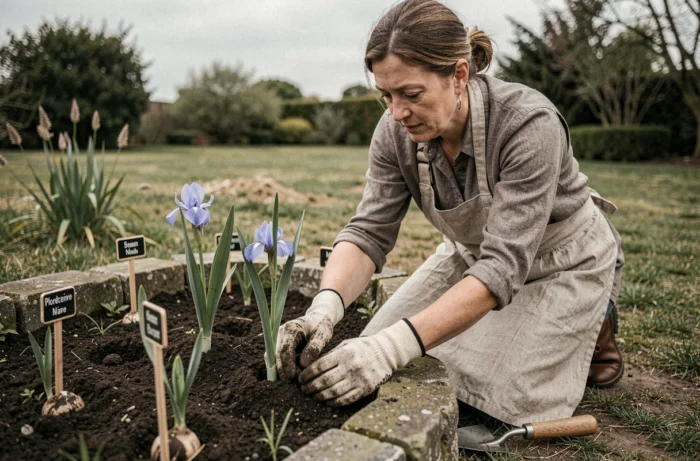
Regulatory status of the walking iris by region
Restrictions regarding exotic ornamental plants are no longer uniform. Recent sources show a rise in territorial regulations rather than a single rule applicable everywhere. The status of the same species can vary between countries, provinces, or administrative regions.
For the walking iris, the risk of escape depends on two combined factors: the local climate and the proximity of sensitive ecosystems (wetlands, marshes, banks). A plant grown in a pot in a Parisian apartment does not pose the same problem as a bed planted in the ground in southern France or in an overseas department.
| Situation | Risk of propagation | Recommended precaution |
|---|---|---|
| Indoor pot (temperate climate) | Negligible | No current restrictions |
| In the ground, area with regular winter frost | Low | Monitor the spread of offsets |
| In the ground, mild winter area (coastal, south) | Moderate | Check local lists of invasive exotic plants |
| In the ground, tropical or subtropical area (overseas) | High | Consult territorial regulations before planting |
The geographical origin and behavior of the plant matter more than its appearance in assessing the risk. An exotic species grown in a pot is not automatically banned, but a species listed in a territorial list may be, even if it is decorative.
Planting and soil suitable for the walking iris
Aside from the regulatory question, the success of planting relies on the choice of substrate and exposure. The walking iris tolerates a fairly wide range of soils, provided that stagnant water at the rhizome level is avoided.
- A light, draining soil enriched with organic matter is perfect. A mix of potting soil and coarse sand works well both in pots and in the ground.
- The exposure should be bright without burning direct sunlight: bright filtered light or a semi-shaded outdoor location promotes dense foliage and regular flowering.
- The rhizome should be planted at soil level, never buried deeply. A rhizome that is too buried produces foliage but few flower stalks.
- Watering should be moderate: the substrate must dry on the surface between waterings, especially in winter when the plant slows its growth.
Flowering of the walking iris: ephemeral but recurrent
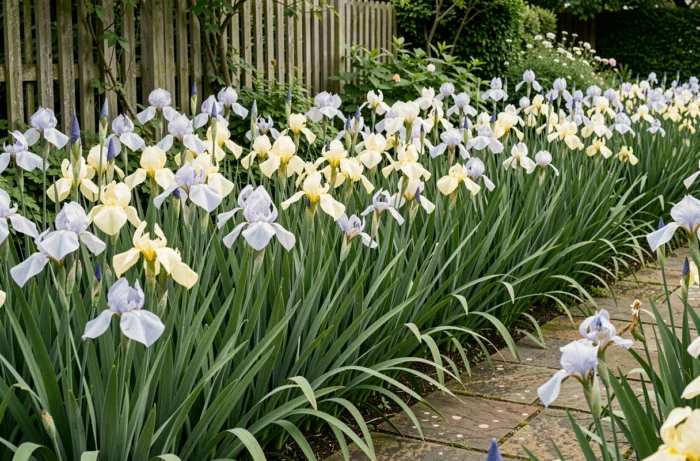
The flower of the walking iris lasts only one day. This brevity often disappoints gardeners who expect a prolonged flowering similar to that of classic garden irises. In contrast, a well-established plant produces several successive stalks throughout the season, which more than compensates for the short duration of each individual flower.
Flowering occurs on stalks that also bear future offsets. Once the flower has faded, a seedling forms at the end of the stalk, which becomes heavy and bends toward the ground. This dual role (flowering then propagation) explains why systematically cutting the stalks after flowering limits both the multiplication and ornamental potential of the plant.
The fan-shaped foliage, persistent and graphic, remains the main asset of the walking iris outside of flowering periods. The dark green leaves, arranged on the same plane, resemble those of marsh irises without having the same water requirements.
Routine maintenance and mistakes to avoid
The walking iris requires little intervention once established. The most common mistakes concern excess water and lack of light.
- Overwatering causes the rhizome to rot, especially in pots without sufficient drainage. Prefer a container with holes and a substrate that does not retain water.
- A location that is too dark (interior far from a window) produces elongated leaves and suppresses flowering. Light is the primary factor triggering flower stalks.
- In the ground, monitor the aerial offsets that root spontaneously. Remove those that colonize unwanted areas before they become established.
Multiplication occurs naturally through these offsets or by dividing the rhizome. It is one of the easiest plants to propagate, which explains why it circulates abundantly among individuals without always going through controlled sales channels.
Checking the local status of the walking iris before any planting in the ground remains the most useful reflex, especially in regions where winter does not freeze. In pots, the question does not arise: the container acts as a natural barrier, and the plant remains a house iris as easy as it is discreet.