
The regulatory categorization of a natural product intended for an animal determines everything else: formulation, labeling, distribution circuit, legal responsibility. Before choosing a vegetable oil, a hydrosol, or a plant mixture for a dog or a cat, we must identify which regulatory box this product falls into, as the consequences of a misclassification go far beyond a simple labeling defect.
Regulatory Qualification of Natural Products for Animals
A plant-based product for animals can be classified as raw material for animal feed, compound feed, complementary feed, additive, or veterinary medicine. The boundary depends on the composition, the galenic form, and the claimed use.
The expected regulatory designation for plant-based preparations that fall under animal feed is “complementary feed.” The term “dietary supplement” is reserved for the human market. Confusing the two exposes the manufacturer to reclassification by regulatory authorities.
The label must include at least the designation, category, targeted species, detailed composition, instructions for use, precautions, storage conditions, durability date, batch number, and contact information of the responsible operator. The absence of any one of these elements renders the product non-compliant.
We recommend systematically checking that the supplier displays these mentions before integrating a product into an animal’s care protocol. When looking for animal care from La Fibre Câline, the traceability of ingredients and compliance of labeling are among the selection criteria to prioritize.
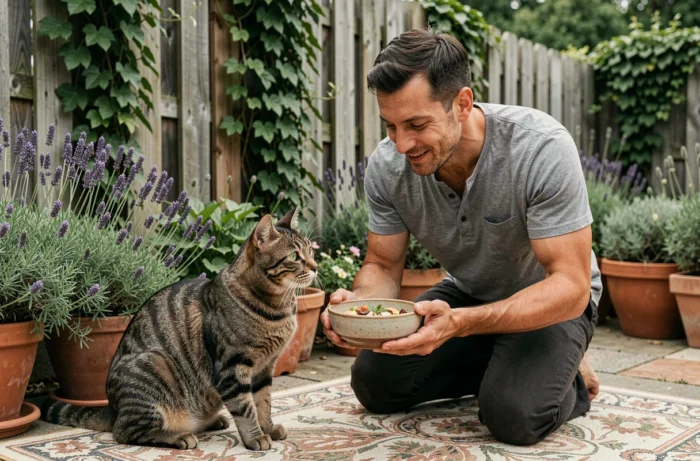
CBD for Dogs and Cats: A Market Withdrawal to Know About
The Ministry of Agriculture published a statement on May 20, 2026, targeting food products containing cannabidiol (CBD) and ordering their withdrawal from the market. Consumers are urged not to purchase these products.
In practice, this concerns CBD oils or treats sold for the “well-being” of dogs and cats, as long as they are positioned as consumable goods or supplements. The marketing discourse highlighting a “natural” use does not change the legal qualification.
For a pet owner looking for a CBD solution for stress or pain management, the situation requires turning to other approaches. Alternatives exist, but they must also comply with the framework described above.
Phytotherapy and Animal Aromatherapy: Technical Precautions
Not all essential oils are compatible with all species. The cat, for example, has a hepatic enzymatic deficiency (glucuronyl transferase) that makes the metabolism of certain phenolic compounds very slow. Applying a potent oil rich in phenols to a cat is akin to administering a substance it cannot eliminate properly.
The essential oils used in breeding follow precise protocols, documented by specialized agricultural press. Transposing these protocols to a pet without dosage adaptation or species verification is a common mistake.
Selection Criteria for a Phytotherapeutic Preparation
- Check that the plant is on the positive list of authorized raw materials in animal feed for the targeted species, and not simply on a list intended for humans.
- Control the galenic form: a concentrated dry extract does not have the same risk profile as a light infusion, even from the same plant.
- Ensure that the product clearly states “complementary feed” with the target species, and not an ambiguous formulation like “for all animals.”
- Require a batch number and contact information of the responsible operator, the only guarantee of traceability in case of adverse effects.

Natural Feeding for Dogs and Cats: Beyond Marketing
The term “natural” on a bag of kibble or a homemade ration does not have a binding regulatory definition in animal feed. A food labeled “natural” can contain technological additives (preservatives, antioxidants) as long as they are of natural origin as defined by regulation.
We observe a recurring confusion between “without additives” and “natural.” A complete dog food without preservatives has a very short shelf life and imposes a storage logistics that most owners do not master. The pertinent question is not “is it natural?” but “does the composition meet my animal’s nutritional needs according to its species, age, and physiological state?”.
Adapting the Ration to the Animal’s Real Needs
A neutered eight-year-old dog and a four-month-old puppy do not have the same needs for protein, calcium, or fatty acids. Choosing a “natural” food without checking nutritional adequacy amounts to prioritizing image over function.
- Have a nutritional assessment conducted by a veterinarian or an animal nutrition specialist before modifying the ration.
- Distinguish marketing claims (“ancestral recipe,” “as in nature”) from the mandatory analytical guarantees on the label (crude protein, fat, crude ash, fiber levels).
- Comparing analytical guarantees between two products rather than their commercial arguments allows for a truly informed choice.
Natural External Care for Skin and Coat
Dermatitis, seasonal itching, and skin irritations are among the most common reasons for consultation. Topical treatments based on hydrosols, vegetable oils, or clay can be a complement, provided they do not delay a veterinary diagnosis.
A technical point often overlooked: the skin pH of dogs differs significantly from that of humans. Using soap or shampoo formulated for human skin, even “natural” and “organic,” disrupts the animal’s skin barrier. The pH of the product must be suitable for the target species, which excludes most repurposed human cosmetic products.
For cat skin care, caution is even greater due to grooming by licking. Any product applied to the coat will be partially ingested. The oral toxicity of the product is as important as its skin tolerance.
Providing suitable natural care for an animal is not just about replacing a conventional product with a plant-based equivalent. It requires mastering the regulatory framework, understanding the metabolic specifics of the species, and reading labels with the same rigor as an animal health professional.