
The Triban RC 120 with a 6061 T6 aluminum frame in a sloping geometry lives up to its promises of lateral rigidity during the first twelve months, but several field reports reveal wear points that the product sheets do not document. We take stock of what the kilometers really change on this bike.
Front brake cable rubbing against the Triban RC 120 frame
This is the most reported issue after six to twelve months of use: the front brake cable, originally too short, rubs against the top tube. The rubbing starts by wearing the paint, then attacks the aluminum if nothing is done.
The cause is simple. The factory-specified cable length leaves little margin during full steering of the handlebars. On a road handlebar in the low position, the tension increases and the cable presses against the frame with every tight turn.
As soon as the bike is received, we recommend applying a protective adhesive film on the contact area of the top tube, even before the first ride. When replacing the cable for the first time (usually between eight and fourteen months), cutting the new cable slightly longer than the original creates a smoother curve.
This issue almost never appears in public feedback, but it affects the long-term condition of the frame. The reviews of the Triban RC 120 according to Bretagne Auto also confirm this premature wear reported by several owners.
Microshift drivetrain and front derailleur: the limits after a year
The Microshift drivetrain mounted on the RC 120 does the job for regular use on flat and rolling terrain. Gear shifting remains crisp as long as the cables are new and the tension is correct.
The problem arises between ten and fourteen months. Several users report a front derailleur that refuses to shift to the large chainring. The most common cause is not the derailleur itself, but the stretching of the cable combined with a slight misalignment of the cage. On an entry-level group, the adjustment tolerances are tighter: a half-turn of the limit screw too much is enough to block the shifting.
Before replacing the derailleur, we recommend checking three elements:
- The cable tension at the adjustment knob on the down tube, taking up the slack accumulated from natural stretching.
- The alignment of the derailleur cage relative to the large chainring, which should remain parallel with a gap of one to two millimeters.
- The condition of the cable housing, which can compress at the ends and create internal friction making the operation feel spongy.
A methodical adjustment resolves the issue in the majority of cases without changing parts.
Freehub body and rear hub play
Another recurring feedback after a year concerns the rear hub developing lateral play. The typical symptom: a slight wobble of the freehub body noticeable when grasping the cassette by hand, sometimes accompanied by a clicking sound while pedaling.
On the entry-level hubs originally mounted, the loose (non-sealed) ball bearings do not handle moisture and dust well. A cyclist riding in rainy weather or on dirty roads accelerates wear. Greasing the cones and tightening the locknut usually suffices to eliminate the play. If the cups are marked, replacing the entire hub remains affordable.
This point deserves attention because unchecked play gradually deforms the freehub body and can damage the wheel axle. Checking the hub play every three to four months prevents a heavier bill.
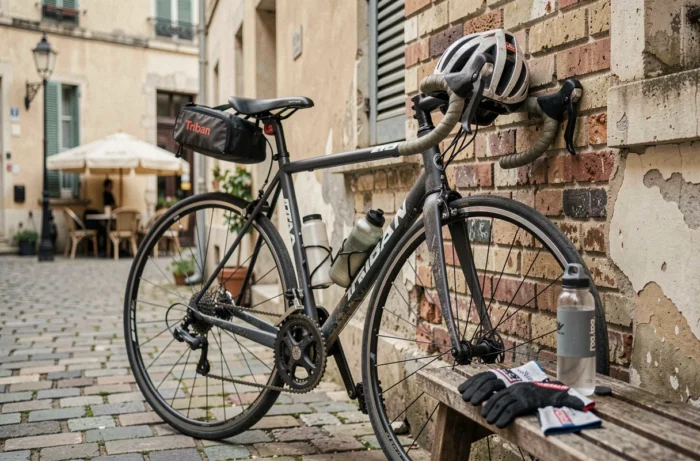
Positioning of the RC 120 in the Decathlon range in 2026
The evolution of the Triban and Van Rysel ranges at Decathlon repositions the RC 120. With the upgrading of gravel models and the redesign of the Van Rysel series, the RC 120 is now perceived more as an entry-level road bike or a commuting tool than as a long-term sports upgrade base.
The availability of the model has also decreased. Users looking for a new RC 120 often face stock shortages, pushing them either towards the RC 100 (less equipped, without road handlebars) or towards the second-hand market.
On the second-hand market, a well-inspected used RC 120 remains an excellent entry point provided that the condition of the points mentioned above is checked: cables, rear hub, and frame paint at the top tube level.
RC 100 or RC 120: what really makes the difference
The road handlebars of the RC 120 fundamentally change the position and upgrade possibilities. The RC 100 with its flat handlebars is suitable for urban commuting, but limits upgrade options (stem, handlebar tape, levers). For a cyclist considering regular rides of over thirty kilometers, the extra cost of the RC 120 is justified by the comfort of the low positions and compatibility with standard road accessories.
The Triban RC 120 remains a decent bike for its price. Its weaknesses, which become apparent after a year, are more related to preventive maintenance than design flaws. Owners who anticipate cable wear, monitor the rear hub, and protect the frame from the start significantly extend the lifespan of the whole.