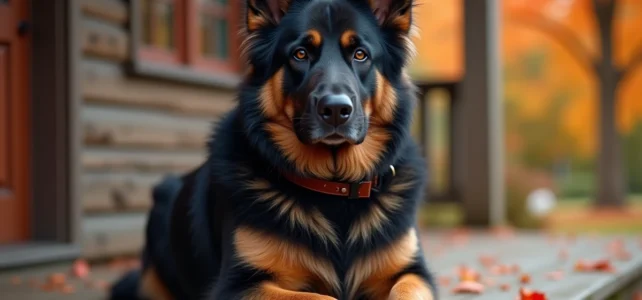
When you adopt a puppy that is a cross between a German Shepherd and a Newfoundland, the first surprise often comes at the weigh-in at the veterinarian’s office. Growth accelerates quickly, the size exceeds projections, and the usual benchmarks of a pure breed no longer apply. This German Shepherd-Newfoundland mix produces a dog with a hybrid temperament, halfway between the alertness of the former and the massive gentleness of the latter, with needs that neither breed fully reveals.
Regulations and traceability of non-LOF crosses in France
Before discussing character or coat, we must establish a framework often overlooked by future owners. A German Shepherd crossed with a Newfoundland cannot be registered in the LOF. It will be identified as “mixed” on its identification card, without any mention of an official breed. This distinction has direct consequences for resale, insurance, and access to certain exhibitions.
Recent European measures aim to more strictly regulate breeding and crossings, particularly by limiting inbreeding (parents/offspring, siblings) and enhancing the traceability of breeders. These rules also apply to non-LOF litters. Specifically, if you adopt this type of mixed breed from a private individual, you should ensure that both parents have valid identification and an up-to-date health record.
To learn everything about the German Shepherd crossed with Newfoundland and its administrative specifics, it is better to gather information before adoption rather than at the time of an insurance refusal.
Size and growth of the German Shepherd-Newfoundland mix
We are talking about a dog that will gain a lot of mass in a short time. The Newfoundland contributes a heavy bone structure and a broad chest, while the German Shepherd often imparts a longer, more angular silhouette. The result varies from one litter to another, sometimes even between puppies from the same litter.
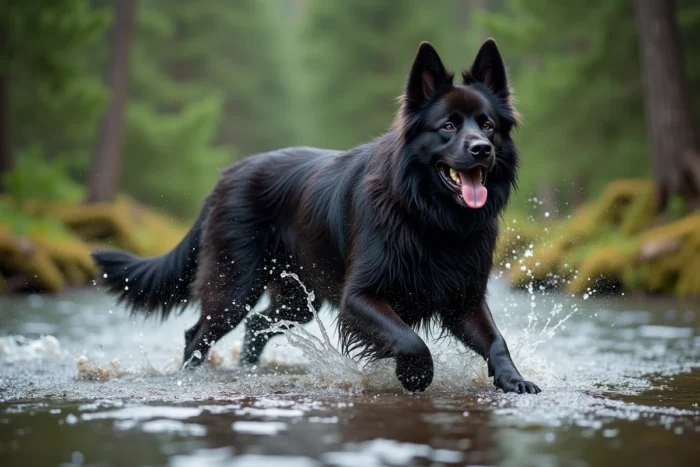
Rapid growth requires close veterinary monitoring during the first twelve to eighteen months. The joints bear weight before they are mature, and hip dysplasia poses a risk inherited from both parent lines. The diet should be adjusted with a formula for large breeds, monitoring weight gain month by month.
The coat also raises practical questions. Generally, you inherit a dense, sometimes medium-length fur, with a thick undercoat passed down from the Newfoundland. Brushing becomes a regular ritual, at least two to three times a week, more during shedding periods.
- Monitor the posture from the fourth month, especially if the puppy is gaining weight quickly in the hindquarters
- Favor a controlled growth diet (large breed kibble, appropriate calcium levels)
- Plan for regular brushing with an undercoat comb to avoid tangles and skin irritations
- Limit jumping and stairs until bone growth is complete
Everyday temperament: between alertness and placidity
The German Shepherd is a working dog, reactive, focused on its owner, with a low alert threshold. The Newfoundland, on the other hand, displays an almost unflappable calm and a high tolerance for children and other animals. You end up with a mix whose temperament oscillates between active protection and family gentleness.
In practice, this dog is well-suited to a family with children, provided that its training is structured from the start. The size necessitates serious leash training before six months, because an adult of this size that pulls cannot be held back by anyone.
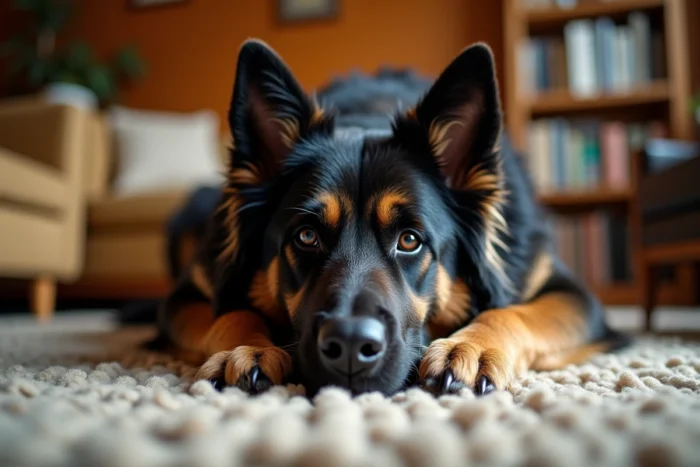
Feedback varies on the daily energy level. Some individuals inherit more of the dynamism of the German Shepherd and require vigorous activities, while others lean towards the nonchalance of the Newfoundland. Observing the puppy from the first weeks helps calibrate the lifestyle that will need to be offered.
Training and socialization of a large mix
Several French dog trainers now regularly work with large mountain and working type mixes. This is no longer an anecdotal profile in socialization centers, and the method differs significantly from that applied to a pure German Shepherd.
The central point is the socialization window. You have about three months to expose the puppy to as many situations as possible (urban noises, other dogs, vehicles, children). After this period, a poorly socialized large mix can develop reactivity, amplified by its size.
- Start socialization sessions before the end of the third month, even if the vaccination protocol is not complete (by choosing controlled environments)
- Work on recall in enclosed spaces before any off-leash outings, especially in forests where regulations often require leashing
- Use positive reinforcement rather than physical coercion, which is ineffective and counterproductive for a dog of this size
A well-socialized mix becomes a stable and reliable companion, capable of adapting to various contexts. The training work requires consistency rather than intensity.
Forest walks and legal framework for large dogs
This type of mix is often found on walks in natural environments, parks, forests, and rural paths. In France, the regulations regarding dog freedom in forests are rarely known by owners. According to prefectural orders, the release of a dog in the forest may be prohibited during certain periods, particularly in spring and summer to protect wildlife.
With a dog whose weight far exceeds that of a standard German Shepherd, the question of control outdoors becomes concrete. An anti-pull harness suitable for very large sizes and a five-meter long line provide a good compromise between freedom of movement and control.
The German Shepherd-Newfoundland mix is neither a lap dog nor a kennel dog. It is a field companion that requires space, monitored nutrition, early education, and an owner ready to adapt their daily life to an unusual size. The reward is a dog with a rare balance, loyal, patient with children, and solid in its relationship with its family.