Michelin does not recruit based on CVs. The group selects candidates based on behavioral aptitudes, trains them internally, and structures their progression around distinct career paths. This HR mechanism, inherited from a century-old social policy, produces atypical career trajectories in the French industry. Understanding these mechanisms allows one to assess whether a long career at Michelin aligns with a realistic professional project.
Decent salary and overall compensation policy at Michelin
In 2024, Michelin formalized a commitment to decent wages. The initiative goes beyond merely adhering to local minimum wage laws: it aims to cover the significant needs of employees and their families, including housing, food, health, and education. This approach surpasses the conventional framework of the metallurgy sector.
In practice, compensation at Michelin combines a base salary, a profit-sharing scheme linked to the group’s results, participation, and a company savings plan. These components vary according to the site, position, and seniority.
The distinguishing factor remains social coverage. Michelin funds health protection, family support systems, and programs for the inclusion of people with disabilities. Considering a career at Michelin requires evaluating this overall package, not just the salary line of the contract.

Internal mobility and job transformation by 2030
Internal mobility at Michelin does not operate as a simple hierarchical promotion system. The group anticipates the restructuring of its jobs as part of the strategic plan “Michelin in Motion 2030”. The directions discussed in 2026 with social partners include the evolution of industrial skills towards hybrid profiles.
Artificial intelligence is reshaping the group’s career trajectories. Michelin has created a dedicated AI center of excellence for the supply chain, where operational profiles work alongside data specialists. A production technician can now transition to data analysis or process transformation without following a traditional engineering path.
This restructuring opens up three types of career paths:
- In-depth technical expertise, with structured career paths (machining, maintenance, quality control) and recognized mastery levels internally
- The hybrid industry-data trajectory, accessible to operators trained internally on analysis and optimization tools
- Proximity management, with positions as job monitors or team leaders, often filled through internal promotion
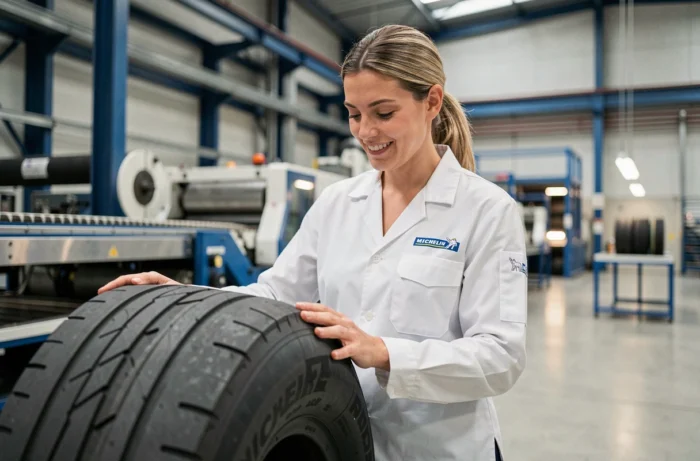
The group recruits based on behavioral competencies and then builds the technical path. This logic allows profiles without prior industrial qualifications to access supervisory roles after several years of internal training.
Continuous training and skill development at Michelin
Michelin positions training as a retention lever, not as a secondary benefit. Each new position comes with a progressive integration program. Production operators are trained by job monitors, who themselves come from production.
Skill development structures the entire employee journey. Training covers both technical skills (turning, milling, industrial vehicle maintenance) and transversal competencies. The group invests in upskilling apprentices, interns, and students, with missions designed to prepare for permanent employment.
For profiles with a high school diploma to a two-year degree, access to technician positions requires internal certifications. Engineers benefit from rotations between sites and functions, with possible international assignments within a group present on multiple continents.
Working conditions and work-life balance in an industrial environment
Ratings given by employees on review platforms provide a measured overview. Based on several hundred evaluations, the work-life balance receives a decent rating without being exceptional. The corporate culture receives the best reviews, while management and job security are judged more nuancedly.
Michelin structures its work environments around quality of life at work programs. Balancing personal and professional life, workstation adjustments, CSR actions in local areas: these initiatives are not cosmetic. They are part of a documented social tradition since the 1920s when Edouard Michelin asserted that the prosperity of the company depended on its social works.
The group relies on a job and career management system (GEPP) to support job evolutions. Employees affected by reorganizations have specific rights regarding support, redeployment, and training.
Desired profiles and Michelin’s recruitment process
The group recruits across a broad spectrum: production agents without prior industrial qualifications, machining technicians, industrial vehicle technicians, software engineers. Soft skills weigh as much as the degree in the selection process, which broadens the talent pool well beyond traditional technical fields.
The job postings on Michelin’s recruitment site cover permanent contracts, apprenticeships, and internships. The missions offered to students are designed to provide real operational experience, not just observation.
- High school level: production operator positions, with complete internal training and potential progression to job monitor
- Two to three-year degree level: technician positions (maintenance, machining, quality control), with internal certification and progressive specialization
- Five-year degree level: engineer positions (development, software, R&D vehicles), with group mobility and international projects
Michelin remains an industrial group whose jobs are rapidly transforming due to data and AI. Candidates who make the most of this company are those who accept changing positions, sites, and sometimes careers every few years. Job stability exists, but it requires the ability to reinvent oneself within a structured framework.