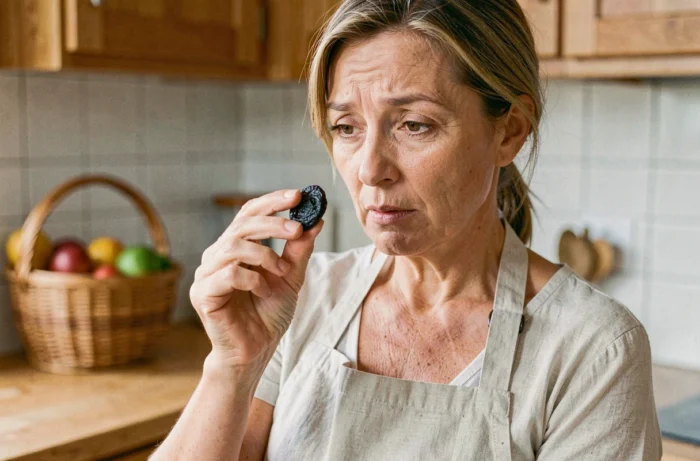
Prunes often display a best before date (BBD) that is several months, sometimes even years, past due at the back of a cupboard. Whether these dried fruits remain consumable after this date depends on measurable parameters: water activity, presence of mold, storage conditions. This article compares what the regulations distinguish (BBD and expiration date), details the actual microbiological risks, and proposes concrete criteria for evaluating a prune whose date has passed.
BBD and Expiration Date on Prunes: Two Dates, Two Levels of Risk
The confusion between these two labels explains a large part of the food that is wrongly thrown away. Here is what each means for a product like the prune.
| Criterion | BBD (“best before”) | Expiration Date (“use by”) |
|---|---|---|
| Type of product concerned | Dried fruits, canned goods, spices | Fresh meats, dairy products, refrigerated dishes |
| Health risk after expiration | Low: loss of taste and nutritional quality | High: possible bacterial growth |
| Legal mention | Sale allowed after the date | Sale prohibited after the date |
| Consequence on the prune | Drier texture, diminished flavor | Not applicable (prunes carry a BBD) |
Prunes, as dried fruits, carry a BBD and not an expiration date. Their very low water content slows bacterial proliferation. Exceeding this date does not turn the product into a dangerous food. It gradually loses flexibility and aroma, without an immediate health risk appearing.
To delve deeper into the question, knowing whether we can eat expired prunes requires clearly distinguishing these two regulatory mentions.
Molds and Pathogens in Dried Fruits: What Microbiological Criteria Show
A dry prune seems safe from contamination. The microbiological reality is more nuanced.
Since January 1, 2025, the Federation of Commerce and Distribution (FCD) has implemented new guidelines that introduce specific criteria for molds and yeasts in the dried fruit category. These texts replace the parameter “enterobacteria” with Escherichia coli and modify the thresholds for presumptive Bacillus cereus and mesophilic aerobic flora.
This change reflects an awareness: the presence of mold on prunes is no longer just a visual defect. It is now integrated into formalized microbiological criteria for market release.
Pathogens That Survive Despite Low Humidity
Foods with low water activity, including prunes, see microbial growth significantly limited. However, several foodborne pathogens can survive for months or even years without actively multiplying. A prune contaminated before drying or during packaging can potentially retain these microorganisms long after the BBD.
This prolonged survival explains why an apparently healthy dried fruit can pose a problem if the initial production or storage conditions were not suitable.
Mycotoxins: An Invisible Risk
Visible molds are just the tip of the iceberg. Some produce heat-resistant mycotoxins, which are not destroyed by cooking or by preparation into compote. The BfR (German Federal Institute for Risk Assessment) reminds us that surface molds signal potential contamination deeper within.
Therefore, removing the moldy part of a prune is not enough to eliminate the risk. If any traces of mold appear, caution dictates discarding the entire batch.
Concrete Criteria for Evaluating Prunes Past Their BBD
Before consuming prunes found at the back of a cupboard, a quick examination can help make a decision.
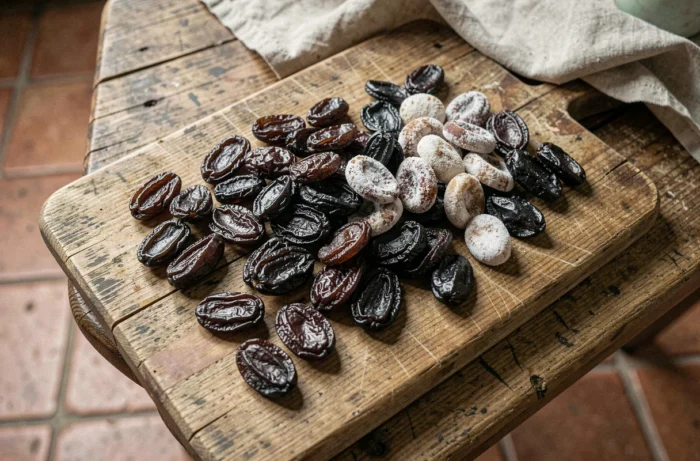
- Visual appearance: no white, green, or gray marks on the surface. A whitish film may indicate sugar crystallization (harmless) or the beginning of mold (to be distinguished by texture, powdery for sugar, fluffy for mold)
- Smell: a healthy prune emits a sweet and slightly tangy note. Any sour, fermented, or rancid smell indicates spoilage
- Texture: a very hard and shriveled prune has lost most of its taste appeal but remains consumable if it shows no other signs of spoilage. An abnormally soft or sticky prune in an intact package deserves more caution
- Packaging: a swollen bag suggests internal fermentation. A punctured package exposes the contents to ambient moisture and cross-contamination
These four checks take only a few seconds. They are more reliable than the printed date on the packaging for judging the actual condition of the product.
Storing Prunes: Conditions That Extend Their Shelf Life
The duration for which a prune remains consumable after its BBD directly depends on its storage environment.
- Stable temperature, lower than the summer room temperature. A cool, dry cupboard is suitable; a refrigerator extends storage
- Absence of direct light, which accelerates the oxidation of aromatic compounds
- Airtight container after opening: a bag sealed with a clip allows moisture to enter. A glass jar with a seal limits air exchange
A prune stored dry and cool in an airtight container remains consumable well beyond its BBD. Conversely, a prune kept in an open bag in a warm, humid kitchen may degrade even before the indicated date.

The BBD printed on a package of prunes is not a health boundary. It indicates the moment when the manufacturer no longer guarantees the product’s suitable qualities.
Visual, olfactory, and tactile examination remains the best indicator for deciding whether to consume prunes whose date has passed. The only red line concerns molds: as soon as they appear, the potentially present mycotoxins render the batch unfit for consumption, regardless of the date on the packaging.